Project Manager: Shreeya Srivastava
Chief Engineer: Adam Lawson
SUBTEAMS:
Mechanical:
The Mechanical team researches materials and brainstorms designs for the drone’s landing gear, frame and arms (using CAD) and collaborates with the Electrical team to integrate the circuitry within the frame.
Electrical:
The Electrical team researches and specifies electronic components for drone flight and additional capabilities like search-and-rescue. This team is also in charge of the autonomous flight control software and sensors.
MISSION:
We aim to design, manufacture and launch two drones within the 24/25 academic year. These projects provide hands-on experience for both sub teams: Mechanical and Electrical/Software to explore drone designs, manufacturing techniques, and team collaboration. We’re in contact with multiple
professors, professionals and graduate students for guidance throughout the project.
PROJECTS:
—Fixed Wing (Tricopter) Drone—
Design Features:
- Tri-propeller configuration (two front-facing, one upward-facing at the back).
- Modular wings for easy replacements.
- Vertical take-off and landing (VTOL) capabilities.
Technical Tools:
- CAD & Simulations: Autodesk Fusion 360 for shape optimization and stress analysis.
- CFD analysis using Ansys for aerodynamic performance.
—Mini PCB Drone —
Design Features:
- Compact frame designed for agility and high-speed maneuvers.
- First-person view (FPV) integration for real-time navigation.
Technical Tools:
- PCB Design: Altium, KiCad, or EasyEDA (to be confirmed).
- FPV Drone Flight Simulator for training and testing.
PROJECT TIMELINE:
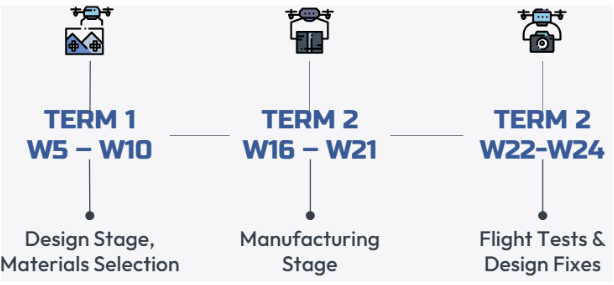
Term 1 (Design Stage)
- Deciding projects and design iterations
- Identifying required tools and resources
Term 2: Weeks 16–21 (Manufacturing Stage)
- Component procurement: Finalizing suppliers and acquiring components, including frames, propellers, and electronics.
- Assembly: Building the fixed-wing drone’s modular frame and integrating the PCB drone’s electrical systems.
- Software integration: Testing ArduPilot for the fixed-wing drone and PCB flight controllers to ensure seamless hardware-software coordination.
Term 2: Weeks 22–24 (Flight Tests & Design Fixes)
The final stage focusing on real-world testing and refinement:
- Flight tests: Conducting initial flights to evaluate stability, maneuverability, and overall performance.
- Data analysis: Collecting telemetry data to identify areas for improvement.
- Design fixes: Making necessary adjustments based on test results to optimize performance and reliability.
 Warwick Aerospace